
Shubh Consultancy Services
Get your GST Return Filing
GST Return Filing Online in India: Complete Guide
Running a GST-registered business comes with an ongoing responsibility that many owners underestimate when they first sign up: filing returns, on time, every single period. It’s not a one-time formality tied to registration — it’s a recurring compliance task that follows your business for as long as it stays GST-registered, whether you’re actively trading or not.
This guide walks through everything a business owner needs to know about GST return filing — what it involves, who it applies to, how the process works, and what happens if deadlines get missed.
An Overview of GST Return Filing
GST return filing is the process through which every GST-registered taxpayer reports their sales, purchases, tax collected, and tax paid to the government within a specified period. It’s the mechanism that keeps the entire GST system functioning — matching what one business declares as sales against what another declares as purchases, so the tax credit chain stays accurate from the manufacturer down to the final consumer.
Since GST replaced a patchwork of state and central indirect taxes in 2017, the return-filing system has gone through several rounds of simplification, but the core idea hasn’t changed: businesses self-report their transactions periodically, and the tax department uses this data to verify compliance, calculate liability, and release input tax credit.
What makes GST returns different from older tax filings is the frequency. Depending on your registration category, you could be filing anywhere from once a month to once a quarter, plus an annual consolidated return — making it one of the more demanding recurring compliance obligations a business takes on.
What is GST Return?
A GST return is a structured document that a registered taxpayer submits to the tax authorities, summarising their business transactions for a given tax period. It typically includes details such as total sales, total purchases, output tax (tax collected on sales), and input tax credit (tax already paid on purchases that can be set off against liability).
Each return is filed electronically through the GST portal, using a specific return form depending on the nature of the taxpayer — regular dealer, composition scheme participant, non-resident taxable person, and so on. The return isn’t just a formality; it’s the basis on which your final tax liability for that period gets calculated, and any mismatch between your reported figures and your supplier’s or buyer’s figures can trigger a notice or a reconciliation issue down the line.
In short, filing a GST return does two things simultaneously: it declares your tax liability to the government, and it validates the input tax credit you’re claiming against purchases made during that period.
Who Must File GST Return Online?
Not every business needs to file every type of return, but broadly, GST return filing applies to:
- Regular registered taxpayers whose annual turnover crosses the applicable threshold for mandatory GST registration
- Composition scheme taxpayers, who file simplified quarterly returns at a lower, fixed tax rate
- E-commerce operators, who are required to file specific returns related to tax collected at source
- Input Service Distributors (ISD), who distribute input tax credit across branches
- Non-resident taxable persons, conducting occasional taxable transactions in India
- Businesses deducting TDS under GST, such as certain government departments and notified entities
- Casual taxable persons, operating temporary or seasonal business activities
Even businesses with zero transactions in a given period are typically required to file what’s known as a NIL return — simply skipping filing because there’s “nothing to report” is a common and costly mistake, since most GST portals still treat non-filing as a compliance lapse regardless of the reason.
Advantages of GST Return Filing
Filing returns on time isn’t just about avoiding trouble — it comes with tangible business benefits:
- Uninterrupted Input Tax Credit: Timely filing ensures your input tax credit claims aren’t blocked or delayed, keeping your working capital healthier.
- Legal Compliance: Avoids notices, penalties, and the risk of registration cancellation for prolonged non-filing.
- Better Access to Credit: Banks and NBFCs increasingly reference GST filing history when evaluating loan applications, since it reflects real business turnover.
- Smoother Vendor Relationships: Buyers often prefer working with consistently compliant suppliers, since their own input credit depends on your filing accuracy.
- Audit Readiness: A clean, consistent filing history makes any future GST audit or scrutiny significantly less stressful.
- Business Credibility: Consistent compliance signals financial discipline to investors, partners, and larger clients evaluating your business.
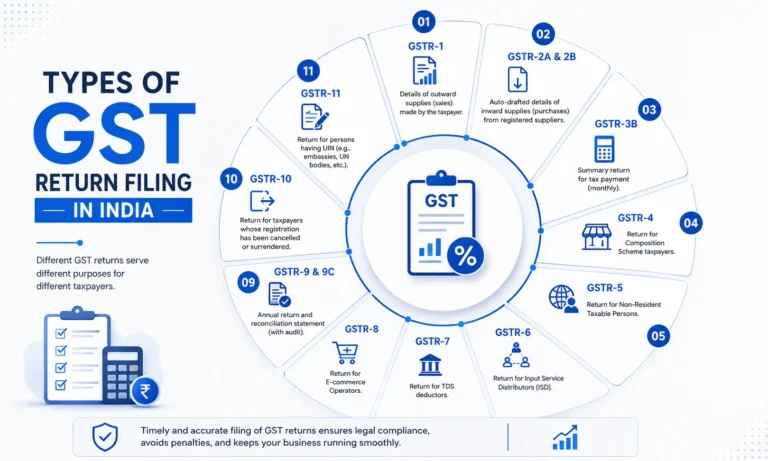
Types of Goods and Service Tax Returns
GST return filing isn’t a single form — it’s a set of different returns, each serving a specific purpose depending on the taxpayer category and transaction type.
| Return Type | Purpose | Filed By |
|---|---|---|
| GSTR-1 | Details of outward supplies (sales) | Regular taxpayers |
| GSTR-3B | Summary return of sales, purchases, and tax payment | Regular taxpayers |
| GSTR-4 | Annual return for composition scheme taxpayers | Composition dealers |
| GSTR-5 | Return for non-resident taxable persons | Non-resident taxpayers |
| GSTR-6 | Return for Input Service Distributors | ISDs |
| GSTR-7 | Return for TDS deductors under GST | TDS deductors |
| GSTR-8 | Return for tax collected at source | E-commerce operators |
| GSTR-9 | Annual consolidated return | Regular taxpayers (above threshold) |
| GSTR-9C | Reconciliation statement with audited financials | Businesses above specified turnover |
| GSTR-10 | Final return on cancellation of registration | Taxpayers cancelling registration |
| GSTR-11 | Return for claiming refunds by UIN holders | Foreign diplomatic missions and embassies |
Most small and medium businesses will primarily deal with GSTR-1 and GSTR-3B on a recurring basis, with GSTR-9 becoming relevant once a year for the annual filing.
Eligibility Criteria for Goods and Services Tax Filing
Filing obligations depend on your registration status and business category rather than a single uniform rule:
- Any business registered under GST, regardless of turnover, is generally required to file returns
- Businesses with annual turnover above the prescribed threshold (currently ₹40 lakhs for goods and ₹20 lakhs for services in most states, with lower limits for special category states) must register and subsequently file
- Businesses voluntarily registered under GST, even below the mandatory threshold, must still file returns once registered
- Composition scheme taxpayers, typically businesses with turnover up to ₹1.5 crore, file under a simplified quarterly structure
- E-commerce sellers and operators must file irrespective of turnover, given the nature of their transactions
Even businesses that later fall below the threshold, or temporarily pause operations, remain obligated to file until their registration is formally cancelled through the appropriate process.
Documents Needed to File GST Return Online
Having the right documentation ready before you sit down to file makes the entire process considerably smoother:
- GSTIN and login credentials for the GST portal
- Sales invoices issued during the tax period
- Purchase invoices and expense bills for input tax credit claims
- Debit and credit notes issued or received
- Details of exempt, nil-rated, and non-GST supplies
- Bank statements, for reconciling reported turnover
- Details of advances received against future supplies, where applicable
- Previous period’s return acknowledgment, for reference and reconciliation
- Digital signature certificate (DSC) or Aadhaar-based e-sign, depending on entity type
Keeping invoices organised and reconciled through the month, rather than compiling them right before the due date, significantly reduces the chances of mismatches or last-minute errors.
Procedure for GST Return Filing
While the exact screens vary slightly by return type, the general filing procedure on the GST portal follows this pattern:
- Log in to the GST Portal using your GSTIN and registered credentials.
- Select the Relevant Return Form based on your taxpayer category and the applicable tax period.
- Enter Outward Supply Details — sales invoices, along with applicable tax rates and amounts.
- Enter Inward Supply Details — purchases and eligible input tax credit, often auto-populated from supplier filings.
- Reconcile Auto-Drafted Data against your own books, correcting any mismatches before proceeding.
- Calculate Net Tax Liability after adjusting available input tax credit against output tax.
- Make Payment, if any liability remains after credit adjustment, through the portal’s payment options.
- Submit and File the return using a Digital Signature Certificate or an Aadhaar-based OTP e-sign.
- Download the Acknowledgment (ARN) as proof of successful filing for your records.
Filing a few days ahead of the due date, rather than on the deadline itself, gives you a buffer to resolve any portal errors or last-minute reconciliation issues without risking a late filing.
Invoices Needed to File GST Return Online
Invoices form the backbone of every GST return, since the entire system runs on matching what one party reports as sales against what another reports as purchases. The key invoice-related documents you’ll typically need include:
- Tax invoices issued for taxable supplies, containing GSTIN, invoice number, date, and applicable tax breakup
- Bill of supply, issued for exempt goods or services, or by composition scheme taxpayers
- Debit notes and credit notes, reflecting any post-invoice adjustments in value or tax
- Export invoices, for zero-rated supplies, along with relevant shipping documentation
- Reverse charge invoices, where the recipient rather than the supplier is liable to pay tax
- Self-invoices, required in specific reverse charge scenarios involving unregistered suppliers
Maintaining these invoices in a structured, digitised format — rather than scattered paper records — makes reconciliation during filing considerably faster and reduces the risk of claiming ineligible input tax credit.
Why Shubh Consultancy Services?
GST on Various Goods and Services
GST in India isn’t a flat, single-rate tax — it’s structured around multiple rate slabs applied differently across goods and services based on their nature and use.
- Essential goods such as unbranded food grains, fresh produce, and certain healthcare items are often exempt or taxed at nil or minimal rates.
- Standard consumer goods — packaged foods, apparel, and household items — typically fall under the moderate tax slabs.
- Luxury and sin goods such as tobacco, aerated drinks, and high-end vehicles attract the highest slab rates, often along with an additional cess.
- Services are generally taxed based on their classification — financial services, professional services, and hospitality each carry their own applicable rates, which can differ from the rate applied to physical goods.
Because GST rates are periodically revised by the GST Council based on economic conditions and policy priorities, it’s important to verify the current applicable rate for your specific goods or services before filing, rather than relying on rates from a previous period.
GST Tax Slabs in India: Old vs New Rates
Since its rollout, the GST rate structure has been revised multiple times by the GST Council to simplify compliance and address inverted duty structures across sectors. Historically, India’s GST framework operated on multiple slabs — commonly referenced as 0%, 5%, 12%, 18%, and 28% — with certain luxury and sin goods attracting an additional cess on top of the highest slab.
Over time, the GST Council has periodically restructured these slabs, in some cases merging or adjusting rates for specific categories to reduce classification disputes and correct situations where input costs were taxed higher than the finished product. Businesses dealing in categories that have seen rate revisions need to pay particular attention to the effective date of any change, since invoices issued before and after a rate revision must reflect the correct applicable rate.
Given how frequently rate structures are reviewed, it’s advisable to check the current notified rates on the official GST portal or council notifications for your specific product or service category before finalising invoices or filing returns, rather than relying on rates that may have since been revised.
Latest GST Rates List for 2025
GST rates for 2025 continue to be governed by classifications set out under the Harmonized System of Nomenclature (HSN) for goods and the Services Accounting Code (SAC) for services. Rates are periodically reviewed and notified by the GST Council, and any business dealing in multiple product or service categories should cross-check applicable rates at the HSN/SAC code level rather than relying on general industry assumptions.
For the most accurate and current rate applicable to a specific good or service, it’s best to refer to the latest rate notification available on the official GST portal, since rates for individual categories can be revised between council meetings without necessarily changing the broader slab structure. Filing returns using an outdated rate — even if the general slab hasn’t changed — can lead to short payment of tax and subsequent notices during reconciliation.
Key Provisions of Cess, TDS & TCS under GST in India
Beyond the standard tax rates, GST law includes a few additional mechanisms that specific categories of taxpayers need to account for:
GST Compensation Cess: Levied over and above the standard GST rate on specified luxury and sin goods — such as tobacco products, aerated beverages, and certain automobiles. This cess is typically not eligible for input tax credit in the same way as standard GST, and needs to be tracked and reported separately in returns.
TDS under GST: Certain notified entities, including specified government departments and public sector undertakings, are required to deduct tax at source on payments made to suppliers above a specified contract value. The deducted amount must be deposited with the government and reported through GSTR-7, and the supplier can claim credit for the TDS deducted against their own liability.
TCS under GST: E-commerce operators are required to collect tax at source on the net value of taxable supplies made through their platform by other sellers. This collected amount is reported through GSTR-8 and reflects in the seller’s electronic cash ledger, which they can use to offset their own tax liability.
Businesses that fall under any of these categories need to track cess, TDS, or TCS obligations separately from their regular output tax liability, since these amounts follow distinct reporting and reconciliation rules within the broader return-filing framework.
Due Dates for GST Return Filing
Return due dates vary by return type and taxpayer category, though most follow a predictable monthly or quarterly rhythm:
| Return Type | Filing Frequency | Typical Due Date |
|---|---|---|
| GSTR-1 | Monthly / Quarterly (QRMP scheme) | 11th of the following month (monthly filers) |
| GSTR-3B | Monthly / Quarterly | 20th of the following month (monthly filers) |
| GSTR-4 | Annual | 30th April of the following financial year |
| GSTR-9 | Annual | 31st December of the following financial year |
| GSTR-9C | Annual | Along with GSTR-9, where applicable |
Exact due dates can shift due to government notifications, extensions, or state-specific staggered deadlines under the QRMP scheme — always verify the current due date on the official GST portal before filing.
Businesses under the Quarterly Return Monthly Payment (QRMP) scheme follow a slightly different rhythm, filing GSTR-1 and GSTR-3B quarterly while still making monthly tax payments through a simplified challan.
What is the Penalty for Delay in GST Return Filing?
Missing a GST return deadline triggers automatic consequences under the law, regardless of whether the delay was intentional or accidental:
- Late Fee: A daily late fee applies for each day of delay, calculated separately for CGST and SGST components, until the return is filed.
- Interest on Tax Liability: Any unpaid tax attracts interest, calculated on a per-annum basis from the original due date until the date of actual payment.
- Blocked Input Tax Credit: Persistent non-filing can affect your ability to claim input tax credit, and can also block your buyers from claiming credit on purchases made from you.
- E-Way Bill Restrictions: Continued non-filing beyond a specified period can restrict your ability to generate e-way bills, directly affecting your ability to move goods.
- Registration Cancellation: Prolonged non-filing, typically beyond six consecutive months for regular taxpayers, can lead to suo-motu cancellation of GST registration by the tax authorities.
The cumulative cost of habitual late filing — late fees plus interest plus potential credit disruptions — often ends up far higher than the effort it takes to file on time. Setting internal reminders a few days before each due date is a simple habit that prevents most of these consequences entirely.
Frequently Asked Questions
GSTR-1 reports the details of your outward supplies (sales), while GSTR-3B is a summary return covering both sales and purchases, used to calculate and pay your net tax liability for the period.
Yes, businesses with zero transactions during a tax period are still required to file a NIL return to remain compliant.
Yes, businesses other than companies and LLPs can typically file using an Aadhaar-based OTP e-sign instead of a Digital Signature Certificate.
You'll be liable for a daily late fee and interest on any unpaid tax, and continued non-filing can eventually lead to input tax credit restrictions or registration cancellation.
Yes, composition taxpayers file a simplified quarterly statement and an annual return, at a fixed tax rate on turnover, rather than the standard monthly return structure.
Input tax credit is generally auto-populated based on your suppliers' filings and reconciled against your own purchase records before being adjusted against your output tax liability.
GST returns generally cannot be revised once filed; instead, corrections are typically made in a subsequent period's return through appropriate adjustments.
The most accurate and updated GST rates should be verified through the official GST portal or the latest council notifications, since rates for specific HSN/SAC codes are periodically revised.