
Trademark Rectification in India
A registered trademark is an important business asset, but an entry in the Trademark Register may sometimes contain an error, remain on the register without sufficient justification, or need to be cancelled or varied because of circumstances recognised under trademark law.
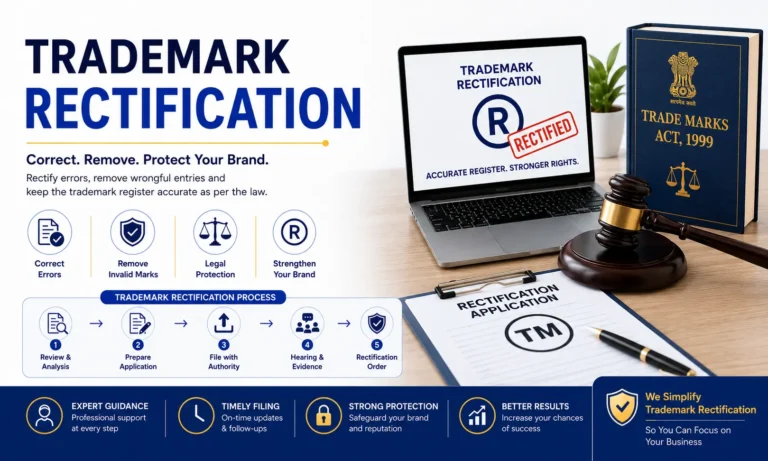
Trademark Rectification is the legal process through which an eligible person can seek an appropriate change to an entry in the Trademark Register. Depending on the circumstances, the proceeding may involve correction, variation, expunging an entry, removal of a trademark, or cancellation or variation of registration.
Section 57 of the Trade Marks Act, 1999 provides the statutory framework for cancellation or variation of registration and rectification of the register. It allows a person aggrieved to approach the appropriate authority in the prescribed manner in circumstances covered by the provision.
At Shubh Consultancy Services, we assist businesses and trademark owners with understanding rectification requirements, preparing supporting information, organising documents, filing assistance, and procedural follow-up.
What is Trademark Rectification?
Trademark Rectification refers to a proceeding for correcting, varying, expunging, or removing an entry from the Trademark Register where the legal requirements for such relief are satisfied.
The purpose of rectification is not simply to change information because the proprietor prefers a different entry. The applicant needs to establish a legally recognised basis for seeking the requested relief.
Under Section 57, a person aggrieved may seek appropriate action where, for example, an entry has been made without sufficient cause, remains wrongly on the register, or contains an error or defect. The provision also covers cancellation or variation of registration in specified circumstances.
Why is Trademark Rectification Required?
A rectification proceeding may become relevant when the Trademark Register does not accurately or lawfully reflect the position that should exist.
Some situations may include:
- A trademark entry contains an error or defect.
- A trademark has been entered or retained without sufficient cause.
- A registered mark is sought to be removed on an applicable legal ground.
- Registration has allegedly been obtained or maintained in circumstances covered by the Act.
- A condition associated with registration has not been observed.
- An entry in the register needs to be varied or corrected.
- A trademark is being challenged on the ground of non-use where the statutory requirements are satisfied.
The appropriate remedy depends on the facts and the specific provision under which the application is made.
Trademark Rectification Under Section 57
Section 57 of the Trade Marks Act, 1999 is one of the principal provisions dealing with rectification of the Trademark Register.
It provides for applications by a person aggrieved where there is, among other things:
- An entry made without sufficient cause;
- An entry wrongly remaining on the register;
- An error or defect in an entry;
- A need to make, expunge, or vary an entry; or
- A ground for cancellation or variation of registration covered by the provision.
The Registrar or the High Court may have jurisdiction depending on the circumstances and the applicable statutory provisions. In certain infringement proceedings, questions concerning validity of registration are required to be dealt with through rectification proceedings before the High Court under Section 125.
Trademark Rectification for Non-Use
Non-use can be an important ground in appropriate trademark proceedings.
Section 47 deals specifically with removal of a trademark from the register and imposition of limitations on the ground of non-use.
A non-use proceeding should not be filed merely because the trademark owner appears to have limited online activity. The statutory requirements and the relevant period of non-use must be examined carefully.
Evidence may include information concerning:
- Commercial use of the mark
- Goods or services covered by the registration
- Sales activity
- Advertising
- Business records
- Market presence
- Relevant dates
- Circumstances surrounding use or non-use
Whether a non-use ground succeeds depends on the evidence and applicable statutory requirements.
Grounds for Trademark Rectification
The grounds for Trademark Rectification depend on the nature of the application.
Common grounds that may arise include:
1. Entry Made Without Sufficient Cause
A person aggrieved may challenge an entry where it was made without sufficient cause as contemplated by the Act.
2. Wrongful Continuation of an Entry
A trademark may be challenged where the circumstances justify removal or variation of an entry that is wrongly remaining on the register.
3. Error or Defect in the Register
An error or defect in a registered entry may provide a basis for seeking appropriate correction or variation where the relevant legal requirements are satisfied.
4. Non-Use
Where the statutory conditions under Section 47 are met, a registered trademark may be challenged on grounds relating to non-use.
5. Contravention of a Registered Condition
Section 57 also addresses cancellation or variation where there has been a contravention of, or failure to observe, a condition entered on the register in relation to the trademark.
6. Other Statutory Grounds
Depending on the circumstances, other provisions of the Trade Marks Act may become relevant. The exact ground should be identified before filing rather than using a generic rectification claim.
Who Can File a Trademark Rectification Application?
A rectification application is not simply available to every person who dislikes a registered trademark.
Under Section 57, the statute refers to a “person aggrieved” in the relevant circumstances.
The applicant should therefore be able to explain the nature of their interest and the reason why the existing entry affects their rights or interests.
Depending on the case, the applicant may be:
- A business affected by the registered mark
- A proprietor of an earlier trademark
- A person claiming rights in a conflicting mark
- A party affected by an incorrect entry
- Another person having a legally relevant interest
The eligibility should be assessed based on the specific facts.
Trademark Rectification Process in India
The Trademark Rectification Process in India generally involves the following stages.
Step 1: Identify the Registered Trademark
First, identify the trademark registration that is being challenged.
Important information may include:
- Registered trademark number
- Trademark representation
- Proprietor name
- Class
- Goods or services
- Registration details
- Relevant dates
Step 2: Determine the Legal Ground
The applicant should identify why rectification is being requested.
This may involve:
- Non-use
- Incorrect entry
- Error or defect
- Wrongful continuation
- Contravention of a condition
- Another applicable statutory ground
Step 3: Collect Supporting Evidence
The applicant should gather documents that establish the facts relied upon in the rectification proceeding.
Step 4: Prepare the Application
The application and accompanying statement should explain the applicant’s interest, relevant facts, grounds, and relief sought.
Step 5: File Before the Appropriate Authority
The application must be filed before the authority having jurisdiction under the applicable provisions and in the prescribed manner.
Step 6: Notice to the Registered Proprietor
Depending on the procedure, the registered proprietor and other interested persons may receive notice and an opportunity to respond.
Step 7: Counterstatement
The registered proprietor may contest the rectification application by filing the prescribed counterstatement within the applicable period.
Step 8: Evidence
The parties may be required to submit evidence supporting their respective positions.
Step 9: Hearing
Where required, the parties may receive an opportunity to present their submissions before the competent authority.
Step 10: Decision
After considering the pleadings, evidence, and submissions, the competent authority may pass an appropriate order.
Documents Required for Trademark Rectification
The documents depend on the ground and facts of the case. Commonly relevant documents may include:
- Trademark registration details
- Trademark registration certificate
- Details of the registered proprietor
- Details of the applicant
- Trademark Journal information, where relevant
- Earlier trademark registration or application details
- Evidence of prior use
- Sales invoices
- Advertising material
- Product packaging
- Website records
- Business documents
- Evidence relating to non-use
- Correspondence concerning the trademark
- Supporting affidavits or statements
- Authorisation documents
- Other evidence supporting the grounds of rectification
Not every document is required in every case. The evidence should be selected according to the specific ground being relied upon.
Evidence in Trademark Rectification Proceedings
Evidence can be particularly important where the dispute concerns use, prior rights, ownership, or the circumstances surrounding registration.
Depending on the case, evidence may include:
- Dated invoices
- Tax invoices
- Product photographs
- Packaging
- Advertisements
- Brochures
- Website pages
- Social media records
- Sales figures
- Distribution records
- Business correspondence
- Market research
- Trademark usage material
Documents should be organised chronologically wherever possible so that the relevant history can be understood clearly.
Trademark Rectification Hearing
A Trademark Rectification Hearing may be conducted when the matter reaches the hearing stage.
During the hearing, the parties may be required to address:
- Grounds raised in the application
- Counterstatement
- Evidence
- Earlier rights
- Use or non-use
- Errors in the register
- Relevant statutory provisions
- Relief requested
The hearing should focus on the issues actually supported by the pleadings and evidence.
Trademark Rectification Application
A Trademark Rectification Application should clearly identify the trademark entry being challenged and explain the legal and factual basis of the request.
The statement accompanying the application should ordinarily explain:
- Applicant’s interest
- Trademark registration details
- Relevant facts
- Grounds of rectification
- Evidence relied upon
- Relief requested
Rule 97 of the current Trade Marks Rules, 2017 provides that an application for rectification or removal under the specified sections is accompanied by a statement setting out the nature of the applicant’s interest, facts relied upon, and relief sought.
Why Shubh Consultancy Services?
Trademark Rectification Form
The prescribed form should be checked carefully before filing because the official IP India materials currently show different references.
The current Trade Marks Rules page states under Rule 97 that applications for rectification or removal under Sections 47, 57, 68 or 77 are to be made in the prescribed form and currently refers to Form TM-O.
However, the current official Forms & Official Fees page separately lists applications under Sections 47 to 57 for rectification or removal against Form TM-26, including a prescribed government fee. Applicants can also refer to the official Form TM-26 for the relevant filing details.
Therefore, before filing, the applicant should verify the form currently enabled or prescribed for the particular filing through the official IP India system.
Trademark Rectification Fees
Trademark rectification involves applicable government filing fees, which may depend on the type of proceeding and filing method.
The current official IP India Forms & Official Fees page lists an application under Sections 47 or 57 for rectification of the register or removal of a trademark from the register at ₹3,000 for physical filing and ₹2,700 for e-filing, with TM-26 shown as the corresponding form.
Professional fees, documentation charges, evidence preparation costs, and representation charges, if any, are separate from government fees.
Because government fees and filing requirements can change, applicants should verify the latest official fee schedule before filing.
Trademark Rectification vs Trademark Cancellation
The terms rectification and cancellation are sometimes used interchangeably, but they can describe different forms of relief depending on the proceeding.
Rectification can involve:
- Correcting an entry
- Varying an entry
- Expunging an entry
- Removing a trademark
- Cancelling or varying registration where the applicable statutory requirements are met
The exact relief depends on the legal provision and facts of the case.
Trademark Rectification vs Trademark Objection
These two processes occur at different stages.
| Trademark Objection | Trademark Rectification |
|---|---|
| Usually arises during examination of a pending application | Generally concerns an existing entry or registration |
| Raised through the examination process | Initiated through a prescribed rectification proceeding |
| Applicant responds to Registry objections | Applicant seeks correction, variation, removal or other relief |
| Usually concerns registration of a pending application | Concerns the Trademark Register or an existing registration |
A trademark objection should therefore not be confused with a rectification proceeding.
Trademark Rectification vs Trademark Opposition
Trademark Opposition generally allows a third party to challenge a trademark application after publication in the Trade Marks Journal and before registration.
Trademark Rectification generally concerns an existing registration or an entry in the Trademark Register and seeks an appropriate correction, variation, expunging, or removal based on the applicable law.
The two proceedings therefore operate at different stages of the trademark lifecycle.
Trademark Rectification and Trademark Cancellation for Non-Use
Where the issue relates specifically to non-use, Section 47 should be considered because it deals with removal from the register and limitations on the ground of non-use.
A non-use proceeding requires careful assessment of the relevant statutory conditions and evidence.
It is therefore better to evaluate the trademark’s history and use before deciding whether non-use is an appropriate ground.
Jurisdiction for Trademark Rectification
Jurisdiction is an important consideration in rectification proceedings.
Section 57 provides for applications to the Registrar or High Court as applicable, while Section 125 deals specifically with situations where the validity of a trademark registration is questioned in an infringement suit. In such circumstances, the rectification application is to be made to the High Court.
Accordingly, the appropriate forum should be determined from the facts and the statutory provision applicable to the proceeding.
How Long Does Trademark Rectification Take?
There is no single fixed timeline applicable to every trademark rectification matter.
The duration can depend on:
- Complexity of the dispute
- Number of parties
- Evidence involved
- Registry workload
- Hearings
- Procedural filings
- Requests for additional time
- Whether the matter reaches the High Court
- Any related proceedings
Applicants should therefore avoid relying on a guaranteed completion period.
What Happens After Filing Trademark Rectification?
After filing, the proceeding may move through notice, counterstatement, evidence, hearing, and decision stages depending on the nature of the matter.
The registered proprietor may contest the application, and both parties may be required to substantiate their respective positions.
The final outcome depends on the pleadings, evidence, arguments, and findings of the competent authority.
Can a Registered Trademark Be Removed?
Yes, a registered trademark may be removed from the register where the applicable statutory grounds and procedural requirements are satisfied.
Section 57 expressly provides for orders involving cancellation or variation of registration and making, expunging, or varying entries in the register. Section 47 separately addresses removal on grounds of non-use.
Removal is not automatic merely because someone files an application. The grounds must be established according to the applicable procedure.
Can a Trademark Registration Be Corrected?
Yes. The Trade Marks Act also contains provisions concerning correction of the register.
Section 58 allows the Registrar, on an application made in the prescribed manner by the registered proprietor, to correct certain errors in the name, address, or description of the proprietor or other entries, enter certain changes, cancel an entry, or strike out goods or classes in specified circumstances.
Therefore, where the issue is simply a proprietor detail or another correction covered by Section 58, a rectification proceeding under Section 57 may not necessarily be the appropriate route.
Trademark Rectification for Incorrect Details
Where a registered trademark contains incorrect proprietor information, address details, or another correctable entry, the appropriate statutory provision should first be identified.
Section 58 specifically provides for certain corrections and changes in the register on application by the registered proprietor.
This distinction is important because every correction request is not necessarily a Section 57 rectification case.
Common Mistakes in Trademark Rectification
Applicants should avoid the following mistakes:
- Filing without identifying a proper legal ground
- Using irrelevant evidence
- Ignoring the applicant’s requirement to show an appropriate interest
- Providing incomplete registration details
- Relying only on unsupported allegations
- Missing procedural deadlines
- Confusing rectification with trademark opposition
- Confusing rectification with a simple correction request
- Using an outdated form without checking current requirements
- Failing to review related court proceedings
A properly structured application should connect the facts, legal grounds, evidence, and relief requested.
How Shubh Consultancy Services Can Help
Trademark rectification proceedings can involve detailed documents, statutory provisions, evidence, and procedural requirements.
Shubh Consultancy Services can assist with:
- Trademark registration record review
- Identification of relevant rectification grounds
- Document checklist preparation
- Evidence organisation
- Trademark Rectification Application assistance
- Form and filing requirement guidance
- Government fee verification
- Counterstatement-related assistance
- Hearing preparation
- Procedural follow-up
- Trademark record-related compliance support
Our approach is focused on understanding the particular trademark issue before selecting the appropriate procedural route.
Get Assistance With Trademark Rectification
A Trademark Rectification matter should be approached carefully because the correct remedy depends on the nature of the registered entry, the applicant’s interest, the legal grounds, and the evidence available.
Whether the issue concerns removal for non-use, an incorrect entry, rectification under Section 57, correction under Section 58, or another issue affecting the Trademark Register, choosing the correct procedure is important.
Shubh Consultancy Services can assist with trademark rectification documentation, application preparation, filing requirements, evidence organisation, hearing preparation, and procedural support.
Contact Shubh Consultancy Services for assistance with Trademark Rectification in India.
Frequently Asked Questions About Trademark Rectification
Trademark Rectification is a legal process for seeking correction, variation, expunging, or removal of an entry from the Trademark Register where the applicable statutory requirements are satisfied.
Section 57 deals with the power to cancel or vary registration and to rectify the Trademark Register. It provides remedies in specified circumstances involving entries, registration conditions, errors, or defects.
Section 57 refers to an application by a person aggrieved in the relevant circumstances. The applicant therefore needs to establish a legally relevant interest in the matter.
Yes, Section 47 specifically provides for removal from the register and limitations on the ground of non-use, subject to its statutory conditions.
Depending on the proceeding, grounds may include an entry made without sufficient cause, an entry wrongly remaining on the register, an error or defect in an entry, non-use under Section 47, or other grounds provided by the applicable provisions.
Documents depend on the case and may include trademark registration details, proof of use or non-use, invoices, advertising material, business records, earlier trademark documents, affidavits, and other supporting evidence.
The process may involve identifying the registration, determining the legal ground, preparing the application, filing it before the appropriate authority, service of notice, counterstatement, evidence, hearing, and final decision.
The current IP India Forms & Official Fees page lists ₹3,000 for physical filing and ₹2,700 for e-filing for an application under Sections 47 or 57 for rectification/removal, with TM-26 shown as the corresponding form. Applicants should verify the latest official fee schedule before filing.
The current official materials should be checked before filing. The current Trade Marks Rules page refers to Form TM-O under Rule 97, while the official Forms & Official Fees page currently lists TM-26 for applications under Sections 47–57.
Not necessarily. Rectification is a broader concept that can include varying, correcting, expunging, or removing an entry. Cancellation may be one form of relief depending on the applicable provision.
No. Opposition generally challenges a pending trademark application after publication, whereas rectification generally concerns an existing registration or entry in the Trademark Register.
Yes. Section 58 provides specific powers for correction and alteration of certain entries in the register.
The timeline varies according to the complexity of the matter, evidence, procedural stages, Registry workload, hearings, and whether court proceedings are involved.
Yes, where the applicable statutory grounds and procedural requirements are satisfied. Section 57 specifically deals with rectification of the register and cancellation or variation of registration.
A non-use challenge may be possible under Section 47 where the statutory requirements are fulfilled.
No. Filing an application does not by itself cancel a trademark. The competent authority must consider the matter and pass an appropriate order.