
Shubh Consultancy Services
Get your Trademark Objection
Trademark Objection in India
Receiving a trademark objection does not necessarily mean that your brand cannot be registered. A trademark application may receive an objection when the Trade Marks Registry identifies an issue with the proposed mark during examination.
A Trademark Objection is generally communicated to the applicant through an examination report. The applicant then gets an opportunity to respond to the objections and provide appropriate explanations, documents, evidence, or other supporting material.
A carefully prepared Trademark Objection Reply can address the concerns raised by the Examiner and help move the application forward.
At Shubh Consultancy Services, we assist businesses, startups, and trademark applicants with examination report review, trademark objection reply preparation, filing assistance, documentation, and related procedural requirements.
What is a Trademark Objection?
A trademark objection is an objection raised by the Registrar or Examiner during the examination of a trademark application.
After a trademark application is examined, the Registrar may communicate an objection in writing through an examination report if there is a concern regarding the acceptance of the mark. Rule 33 of the Trade Marks Rules, 2017 provides for examination of applications and communication of objections through an examination report.
The objection may relate to the nature of the trademark itself, its distinctiveness, similarity with an earlier mark, classification, specifications, or other issues identified during examination.
An objection is therefore a stage in the registration process where the applicant is given an opportunity to respond.
What is a Trademark Examination Report?
A Trademark Examination Report is a communication issued by the Trade Marks Registry after examination of a trademark application.
The examination process may involve a search of earlier trademarks to determine whether an identical or deceptively similar mark is already on record for the same or similar goods or services. If the Registrar has an objection to accepting the application, the objection is communicated to the applicant through the examination report.
The report may mention one or more legal provisions and may also identify specific earlier trademarks or other reasons for the objection.
The applicant should carefully read the entire report before preparing a response.
Why Does a Trademark Application Get Objected?
There can be several reasons for a Trademark Objection. Some of the commonly encountered grounds relate to:
- Lack of distinctive character
- Descriptive or generic nature of the mark
- Similarity with an earlier trademark
- Identity with an existing trademark
- Likelihood of confusion
- Incorrect or unclear classification
- Issues relating to the specification of goods or services
- Other statutory grounds under the Trade Marks Act
- Procedural or documentary deficiencies
The exact reason depends on the examination report issued for the particular application.
Trademark Objection Under Section 9
Section 9 of the Trade Marks Act, 1999 deals with absolute grounds for refusal of registration.
For example, a mark may face an objection where it lacks distinctive character or is not capable of distinguishing the goods or services of one person from those of another. Section 9 also covers certain marks that consist exclusively of descriptive indications or marks that have become customary in the trade.
Therefore, when an examination report raises a Section 9 objection, the response should address the specific ground mentioned by the Examiner.
Depending on the facts, the applicant may need to explain the distinctive features of the mark and, where relevant, provide evidence supporting acquired distinctiveness or use.
Trademark Objection Under Section 11
Section 11 of the Trade Marks Act, 1999 concerns relative grounds for refusal.
An objection under Section 11 may arise where the applied trademark is identical or similar to an earlier trademark and the goods or services are identical or similar in a manner that creates a likelihood of confusion or association among the public.
The examination report may therefore cite one or more earlier trademarks against the applicant’s mark.
A response to such an objection should carefully examine the cited mark, the applied mark, the relevant goods or services, and the overall circumstances of the application.
Types of Trademark Objections
Trademark objections can arise from different aspects of an application.
1. Distinctiveness Objection
The Examiner may question whether the mark is capable of distinguishing the applicant’s goods or services from those of other businesses.
2. Similarity Objection
The application may be objected to because an earlier trademark appears identical or similar.
3. Descriptive Mark Objection
A mark that directly describes characteristics, quality, intended purpose, or other features of goods or services may face an objection under the applicable provisions.
4. Classification or Specification Issues
An objection may also relate to the class selected or the description of goods and services mentioned in the application.
5. Procedural Objection
Some objections may relate to information, documentation, or procedural aspects of the application.
The actual objection should always be determined from the examination report rather than assumed from the trademark status alone.
Trademark Objection Reply
A Trademark Objection Reply is the formal response submitted by the applicant against the objections mentioned in the examination report.
The purpose of the reply is to address the Examiner’s concerns with relevant facts, legal grounds, explanations, and supporting evidence where necessary.
A good reply should not simply repeat that the trademark is unique. It should directly address the specific objections raised in the examination report.
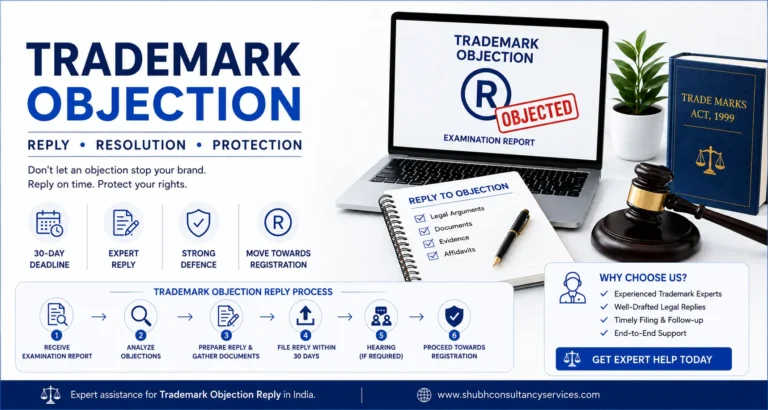
Trademark Objection Reply Process
The Trademark Objection Reply Process generally involves the following steps:
Step 1: Obtain the Examination Report
First, obtain and review the examination report associated with the trademark application.
Step 2: Understand the Objections
Identify the exact sections, grounds, cited trademarks, or procedural issues mentioned by the Examiner.
Step 3: Review the Trademark Application
Check the original application, applicant details, class, specification of goods or services, trademark representation, and filing basis.
Step 4: Analyse the Objection
Determine why the objection has been raised and what information or evidence may be relevant to address it.
Step 5: Prepare the Response
Prepare a structured response dealing with each objection separately.
Step 6: Attach Supporting Evidence
Where appropriate, supporting documents such as proof of use, invoices, promotional material, business records, or other relevant evidence may be considered.
Step 7: File the Reply
Submit the response through the prescribed Trade Marks Registry filing mechanism within the applicable timeline.
Step 8: Monitor the Application
After filing the response, monitor the application for further communication, acceptance, hearing, or other action by the Registry.
Trademark Objection Reply Deadline
The deadline for responding to an examination report is important.
Under Rule 33(4) of the Trade Marks Rules, 2017, if the applicant fails to respond within one month from the date of receipt of the examination report, the Registrar may treat the application as abandoned.
IP India’s Standard Operating Procedure also states that an examination report containing office objections is to be replied to within 30 days from receipt of the examination report.
Because missing the response period can have serious consequences, applicants should check the communication date and act promptly.
What Happens If You Do Not Reply to a Trademark Objection?
Failing to respond within the applicable period can result in the trademark application being treated as abandoned.
Rule 33 specifically provides that where the applicant does not respond within one month from receipt of the examination report, the Registrar may treat the application as abandoned.
Therefore, applicants should not ignore an examination report even if they believe the objection is incorrect.
Documents Required for Trademark Objection Reply
The documents required depend on the grounds mentioned in the examination report.
Depending on the circumstances, relevant documents may include:
- Copy of the trademark examination report
- Trademark application details
- Trademark representation or logo
- Applicant identity details
- Proof of trademark use, where relevant
- Invoices and sales records
- Product packaging or labels
- Advertising and promotional material
- Website or social media evidence
- Business documents
- Affidavit or declaration relating to use, where appropriate
- Details of the applicant’s business activities
- Other supporting evidence relevant to the objection
Not every applicant will need all of these documents. The evidence should be selected according to the specific objection.
Trademark Objection Status
Applicants can check their trademark application status online through the Trade Marks Registry’s online system.
If the status indicates that the application has been objected to, the applicant should review the corresponding examination report and determine whether a reply is pending.
A status such as “Objected” should not automatically be treated as a final refusal. The next step depends on the examination report, response status, and subsequent action by the Registry.
Why Shubh Consultancy Services?
Trademark Registration Status Objected: What to Do?
If your Trademark Registration Status shows “Objected,” the first step is to identify the examination report associated with the application.
The applicant should then:
- Download or review the examination report.
- Identify each objection mentioned in it.
- Check the response deadline.
- Review the application and cited trademarks, if any.
- Prepare an appropriate response.
- Submit the reply within the prescribed period.
- Track the application after submission.
If a hearing is subsequently scheduled, additional preparation may be required.
Trademark Objection Hearing
A trademark objection does not always end with the written reply.
Under Rule 33, where the response to the examination report is not satisfactory or the applicant requests a hearing, the Registrar may provide an opportunity of hearing.
A hearing allows the applicant or authorised representative to make submissions before the Registrar.
Preparation for a Trademark Objection Hearing may involve:
- Reviewing the original examination report
- Reviewing the written reply
- Organising supporting evidence
- Understanding cited trademarks
- Preparing arguments addressing the objections
- Keeping relevant application documents available
The outcome depends on the facts, evidence, submissions, and decision of the Registrar.
Common Reasons for Trademark Objection
Some common reasons include:
Lack of Distinctiveness
A mark may be considered incapable of distinguishing one person’s goods or services from those of others.
Descriptive Nature
A trademark that directly describes characteristics or features of goods or services may face an objection under the applicable provisions.
Similar Earlier Trademark
The Examiner may identify an earlier trademark that is identical or similar to the applied mark.
Likelihood of Confusion
Where the similarity between marks and the relevant goods or services creates a likelihood of confusion, Section 11 may become relevant.
Incorrect Classification
The goods or services may have been placed in a class that does not appropriately correspond with the application.
Unclear Specification
The description of goods or services may require clarification or modification.
How to Respond to a Trademark Objection?
There is no single response that works for every trademark objection.
The response should be based on the exact grounds mentioned in the examination report.
For example, where the objection relates to similarity with an earlier trademark, the response may need to address the differences between the marks, the nature of the goods or services, the relevant market, and other circumstances.
Where the objection relates to distinctiveness, the response may need to explain why the mark is capable of distinguishing the applicant’s goods or services and, where legally relevant, provide supporting evidence.
The strongest approach is to respond to each objection separately and with relevant supporting material.
Trademark Objection vs Trademark Opposition
Trademark objection and trademark opposition are different stages of the trademark process.
| Trademark Objection | Trademark Opposition |
|---|---|
| Generally raised during examination | Raised after publication of the trademark application |
| Comes from the examination process | Initiated by an opposing party |
| Communicated through the examination report | Initiated through an opposition notice |
| Applicant responds to the Examiner’s objections | Applicant responds through the prescribed opposition proceedings |
| Based on examination of the application | Involves proceedings between the applicant and opponent |
Section 21 of the Trade Marks Act provides the statutory framework for opposition to registration after advertisement of an application.
Trademark Objection Fees
The cost associated with responding to a trademark objection can depend on the nature of the filing and the professional assistance involved.
Government fees, where applicable, should be distinguished from professional service charges.
A simple examination report response may have different costs from a matter that progresses to a hearing or requires extensive evidence and additional filings.
Therefore, the applicable fee should be checked based on the specific application and required action.
Can a Trademark Objection Be Removed?
A trademark objection may be addressed through a suitable response if the applicant can satisfactorily deal with the concerns raised by the Examiner.
However, there is no automatic guarantee that filing a reply will result in acceptance.
The Registrar considers the response and relevant material before deciding the next course of action. If the response is accepted, the application may proceed further; if the concerns remain unresolved, further proceedings such as a hearing may arise. Rule 33 provides for consideration of the response and hearing in appropriate circumstances.
What Happens After Filing a Trademark Objection Reply?
After the response is submitted, the Trade Marks Registry considers the reply.
Depending on the circumstances, the application may:
- Proceed towards acceptance and advertisement;
- Receive further communication;
- Be listed for a hearing; or
- Face refusal if the objections remain unresolved.
The exact outcome depends on the application, examination report, response, evidence, and decision of the Registry.
Why Choose Shubh Consultancy Services for Trademark Objection?
Responding to an examination report requires careful attention to the actual objections rather than using a generic response.
At Shubh Consultancy Services, we assist applicants with the procedural aspects of trademark objection responses.
Our assistance can include:
- Examination report review
- Identification of objections
- Trademark application review
- Trademark Objection Reply preparation
- Supporting document guidance
- Filing assistance
- Application status tracking
- Assistance with further procedural requirements
- Trademark hearing-related assistance
Our objective is to make the trademark objection response process organised and easier to manage.
Get Assistance With Trademark Objection Reply
A trademark objection should be addressed promptly because the response period is limited. Reviewing the examination report carefully and preparing a response that directly addresses the stated grounds can help you manage the next stage of the registration process.
Shubh Consultancy Services can assist with Trademark Objection Reply, examination report review, documentation, filing assistance, and related procedural requirements.
Contact us today to get assistance with your Trademark Objection in India.
Frequently Asked Questions About Trademark Objection
A trademark objection is an objection raised during examination of a trademark application when the Registrar identifies an issue that needs to be addressed before the application can proceed.
A Trademark Objection Reply is the response submitted by the applicant addressing the objections mentioned in the examination report.
Under Rule 33 of the Trade Marks Rules, 2017, the applicant generally has one month from the date of receipt of the examination report to respond.
If the applicant does not respond within the prescribed period, the Registrar may treat the trademark application as abandoned.
An examination report is the written communication through which the Registrar communicates objections or proposed conditions concerning acceptance of a trademark application.
A Section 9 objection relates to absolute grounds for refusal, which can include lack of distinctiveness and certain descriptive or customary marks.
A Section 11 objection generally concerns an earlier trademark and the possibility of confusion or association because of similarity between the marks and the relevant goods or services.
The required documents depend on the objection. They may include the examination report, trademark details, proof of use, invoices, promotional material, business records, and other relevant evidence.
Trademark responses can be submitted through the prescribed Trade Marks Registry filing system, subject to the applicable procedure.
“Objected” generally indicates that an objection has been raised during examination and that the applicant may need to respond to the examination report.
No. A trademark objection arises during examination by the Registry, whereas trademark opposition is a proceeding initiated by an opposing party after the application is advertised in accordance with the applicable procedure.
No. An objection is not necessarily a final refusal. The applicant may have an opportunity to respond to the examination report within the prescribed period.
A hearing may be provided where the response is not satisfactory or where the applicant requests a hearing, subject to the applicable procedure.
You can review the status of the trademark application through the online services of the Trade Marks Registry and check the related examination report or correspondence.