
Shubh Consultancy Services
Get your FSSAI Food Registration In Goa
FBO Turnover Upto 1.5 Crore
- 1 year licence : 999 Rs
- 3 year licence : 1999 Rs
- 5 year licence : 2999 Rs
- All-inclusive, no hidden charges
FBO Turnover From 1.5 To 50 Crore
- 1 year licence : 3,999 Rs
- 3 year licence : 7,999 Rs
- 5 year licence : 11,999 Rs
- Govt Fees Extra
FBO Turnover greater than 50 Crore
- 1 year licence : 4,999 Rs
- 3 year licence : 12,999 Rs
- 5 year licence : 19,999 Rs
- Govt Fees Extra
FSSAI Food Licence in Goa — Register Your Food Business the Right Way
Goa is not just India’s favourite tourist destination — it is one of the country’s most dynamic food economies. From the bustling beach shacks of Calangute and Baga to the seafood export units of Vasco da Gama, the Konkani restaurant lanes of Panaji, the cashew processing factories of Ponda, and the growing cloud kitchen scene of Margao — food is at the beating heart of Goa’s identity and economy.
But behind every thriving food business in Goa is a legal foundation that cannot be skipped: FSSAI food registration. The Food Safety and Standards Authority of India (FSSAI) makes it mandatory for every food business operator in the country — regardless of size, location, or type — to hold a valid FSSAI registration or licence before selling, manufacturing, processing, distributing, or storing food.
In Goa, this requirement is enforced by the Food and Drugs Administration (FDA), Government of Goa. Given the state’s massive tourist footfall and its reputation as a food and hospitality destination, FDA Goa carries out regular inspections and compliance checks — particularly in the beach belt and hospitality zones. Operating without a valid FSSAI licence puts your Goa food business at risk of fines, seizure, and forced closure.
Whether you are opening a new shrimp restaurant on the North Goa coastline, packaging kokum sherbet for retail, running a home kitchen through Swiggy, or exporting Goan sausages — this page will tell you exactly which FSSAI licence you need, how to get it, what it costs, and how our experts can help you get compliant without the paperwork stress.
Why Goa's Food Industry Demands Strict FSSAI Compliance
Goa receives over eight million tourists annually. A large proportion of these visitors — both domestic and international — are making food purchasing decisions every single day, at beach shacks, market stalls, resort restaurants, and food delivery apps. The sheer scale of food consumption in the state, combined with the diversity of food businesses serving it, makes food safety compliance not just a legal requirement but a commercial necessity.
The Food and Drugs Administration (FDA) Goa is one of the more actively enforcing state food authorities in India. Hygiene audits for food and sweet outlets are a regular feature. Beach shacks operating without valid documentation are a known target of FDA enforcement, particularly during peak tourist season between October and March.
Beyond enforcement, consumer behaviour in Goa’s tourism economy has shifted. Domestic and international travellers are increasingly checking FSSAI numbers, Google ratings, and hygiene standards before choosing where to eat. Platforms like Swiggy, Zomato, and Amazon Fresh mandate a valid FSSAI number before any food business can list on their platform.
For food entrepreneurs in Goa, FSSAI registration is the single most important first step — before equipment, before location setup, before marketing.
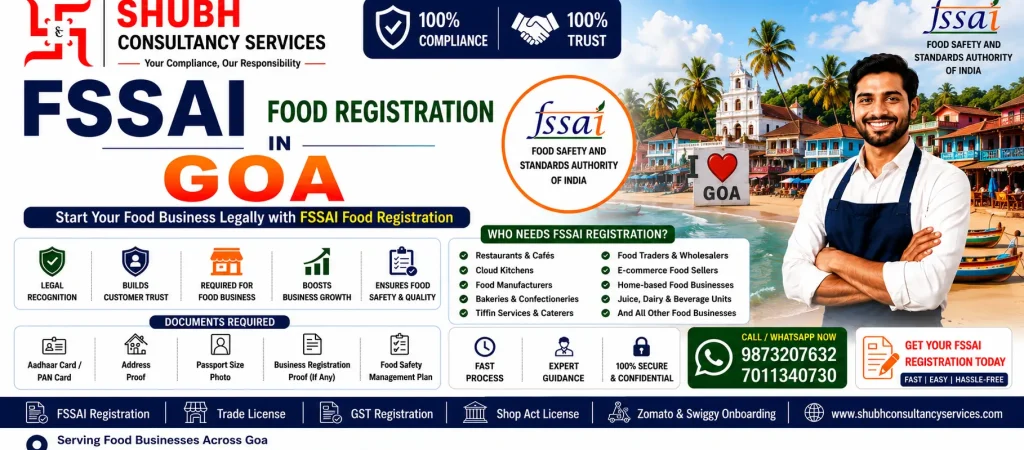
Who Needs FSSAI Registration in Goa?
Every individual or business involved in any stage of the food chain in Goa must hold a valid FSSAI registration or licence. This includes:
Beach Shacks & Seasonal Food Operators: Goa’s iconic beach shacks serve thousands of customers daily during the tourist season. Whether your shack serves prawn curry, feni cocktails, or fresh juice — FSSAI registration is mandatory. Seasonal operation does not exempt you from this requirement.
Restaurants & Cafes: All restaurants, cafes, bistros, and dhabas in Goa — whether in Panaji’s heritage quarters, the backstreets of Anjuna, or Colva beachfront — must hold an FSSAI licence before serving food to the public.
Hotels & Resorts: Properties with in-house kitchens, restaurants, or banquet facilities require FSSAI licensing. Luxury resorts and five-star properties operating across multiple states typically require a Central Licence. Smaller boutique properties and heritage homestays with kitchens fall under the State Licence category.
Seafood Processing & Export Units: Goa’s coastal economy produces significant volumes of fish, prawns, crabs, and molluscs for local sale, interstate distribution, and international export. Every seafood processing unit, cold storage facility, and export packer in Goa must hold a valid FSSAI licence — in addition to any applicable export certifications from MPEDA or the Agricultural and Processed Food Products Export Development Authority.
Cashew Processing Units: The cashew industry is a pillar of Goa’s food economy. Factories and small-scale units processing, packaging, or trading cashew nuts for domestic or export sale must be FSSAI registered.
Goan Specialty Food Manufacturers: Producers of Goan sausages (chouriço), balchão, bebinca, dodol, kokum products, vinegar, and other traditional Goan food products for commercial sale must hold a valid FSSAI licence.
Cloud Kitchens & Home-Based Food Businesses: Home cooks and cloud kitchen operators in Margao, Panaji, Ponda, and across Goa selling through Swiggy, Zomato, Instagram, or WhatsApp must hold FSSAI registration before going live on any platform.
Catering Services: All catering businesses in Goa — for weddings, corporate events, or institutional supply — must hold at least a State FSSAI Licence, regardless of annual turnover. Caterers are specifically excluded from the Basic Registration category under the 2026 FSSAI Amendment Regulations.
Food Distributors & Wholesalers: Businesses supplying food to Goa’s retail stores, hotel kitchens, or interstate distributors must be FSSAI licensed.
Online & E-Commerce Food Sellers: Under FSSAI’s updated digital compliance rules, all food businesses selling through their own website, WhatsApp store, or third-party e-commerce platforms must display their 14-digit FSSAI number prominently on their digital storefronts.
Types of FSSAI Licences Available in Goa
FSSAI classifies food businesses into three categories based on annual turnover and nature of operations. The thresholds below reflect the revised 2026 FSSAI Amendment Regulations, effective 1st April 2026.
Basic FSSAI Registration — For Small Food Businesses (Turnover Up to ₹1.5 Crore)
Basic FSSAI Registration is designed for micro and small food businesses in Goa with an annual turnover of up to ₹1.5 crore. This revised threshold (updated from the earlier ₹12 lakh limit effective 1st April 2026) brings a significantly wider range of small operators — including home bakers, seasonal vendors, small shack operators, and cottage food manufacturers — into the simplest and most affordable compliance category.
Application is made using Form A on the FoSCoS portal. Documentation requirements are minimal. Government fee is ₹100 per year. Under the 2026 perpetual validity amendment, this registration remains active as long as the annual fee is paid — no fixed-term renewal required.
Upon approval, a 14-digit registration number beginning with “2” is issued. This number must be displayed at your premises and on all food packages and digital storefronts.
As your Goa food business grows and annual turnover crosses ₹1.5 crore, you must upgrade to a State FSSAI Licence. Note that caterers are not eligible for Basic Registration regardless of turnover.
Typical Goa food businesses under Basic Registration:
- Home bakers selling Goan sweets, bebinca, or cakes through delivery
- Small beach stall and seasonal food vendors
- Cottage-scale cashew sweet or pickle manufacturers
- Small tiffin services and home cooks
- Local grocery and retail food outlets
- Hawkers and itinerant food vendors at Goa’s markets
State FSSAI Licence — For Mid-Sized Food Businesses (Turnover ₹1.5 Crore to ₹50 Crore)
State FSSAI Licence applies to food businesses in Goa with an annual turnover between ₹1.5 crore and ₹50 crore, operating within the state. This is the most widely applicable licence category for Goa’s restaurants, hotels, manufacturers, seafood processors, caterers, and distributors.
The revised upper threshold of ₹50 crore (updated from the earlier ₹20 crore limit, effective 1st April 2026) brings a larger segment of Goa’s food businesses under state-level regulation by FDA Goa — enabling faster, more locally responsive oversight.
Application uses Form B and requires more detailed documentation including a Food Safety Management Plan, premises layout, list of food products, and applicable NOCs. Government fee ranges from ₹2,000 to ₹5,000 per year depending on the nature of the business.
Typical Goa food businesses under State Licence:
- Restaurants, cafes, and beach shacks with substantial annual revenue
- Hotels and boutique resorts with in-house kitchens (up to 4-star)
- Mid-sized seafood processors and cold storage units
- Cashew processing factories and Goan specialty food manufacturers
- All catering businesses regardless of turnover
- Food distributors, wholesalers, and cold chain operators
- Small to medium packaged food companies
Central FSSAI Licence — For Large & Multi-State Operators (Turnover Above ₹50 Crore)
Central FSSAI Licence is mandatory for food businesses in Goa with an annual turnover above ₹50 crore, as well as all importers and exporters of food products — irrespective of turnover. This revised threshold (updated from the earlier ₹20 crore limit, effective 1st April 2026) ensures that FSSAI’s highest level of regulatory oversight focuses on genuinely large-scale national and international food operators.
Goa-based seafood exporters, large resort chains operating across multiple states, and major packaged food manufacturers are the primary categories requiring a Central Licence. Each unit or branch location in a different state requires a separate State Licence or registration for that specific premises.
Government fee: ₹7,500 per year.
Licence Comparison — Goa (Revised 2026 Thresholds)
| Type | Annual Turnover | Best For |
|---|---|---|
| Basic Registration | Up to ₹1.5 Crore | Home bakers, small vendors, cottage food units, petty retailers |
| State Licence | ₹1.5 Crore – ₹50 Crore | Restaurants, hotels, seafood processors, caterers, manufacturers |
| Central Licence | Above ₹50 Crore | Large manufacturers, exporters, importers, multi-state chains |
Documents Required for FSSAI Registration in Goa
For Basic Registration:
- Photo ID of owner — Aadhaar, PAN card, or Voter ID
- Address proof of business premises — rent agreement, electricity bill, or property tax receipt
- Passport-size photograph of the applicant
- Declaration of nature of food business and food products sold or handled
- Business registration certificate if applicable
For State FSSAI Licence:
- All documents above
- Completed Form B signed by the authorised signatory
- Detailed list of food products to be manufactured, processed, or handled
- Site layout or blueprint of the business premises
- Food Safety Management Plan (FSMP)
- Partnership deed, certificate of incorporation, or GST registration certificate
- Authority letter authorising the signatory
- NOC from local municipal body or panchayat (for food manufacturers)
- Board resolution and owner self-declaration (for companies)
- Ministry of Tourism certificate — compulsory for hotels
- Worker medical fitness certificates (for food manufacturing units)
- Water testing report for pesticide residues (for manufacturers using water in processing)
For Central FSSAI Licence:
- All State Licence documents
- Import Export Code (IEC) issued by DGFT — mandatory for importers and exporters
- Disclosure statement confirming accuracy of all submitted information
- Authorisation letter from Head Office covering each branch location
- Additional documents depending on specialised food category
Step-by-Step FSSAI Registration Process in Goa
All FSSAI applications in Goa are processed online through the FoSCoS portal (foscos.fssai.gov.in), which replaced the earlier FLRS system in Goa with effect from 1st June 2020. The regulatory authority overseeing FSSAI enforcement in Goa is the Food and Drugs Administration (FDA), Government of Goa, headquartered in Panaji.
Step 1 — Assess Your Licence Category
Identify whether your business requires Basic Registration, a State Licence, or a Central Licence based on annual turnover and business type. Note that caterers always require a State Licence, and importers/exporters always require a Central Licence, regardless of turnover.Step 2 — Register on FoSCoS
Create a Food Business Operator account on the FoSCoS portal using your mobile number and email address. OTP verification completes the registration.Step 3 — Compile Documents
Prepare all required documents in clear, legible digital format. Inconsistencies between the application form and supporting documents are the most common reason for rejection.Step 4 — Submit Your Application
Complete and submit Form A (Basic) or Form B (State/Central) on the FoSCoS portal. Attach all declarations, resolutions, and supporting documents before final submission. A unique reference code is generated upon submission for tracking purposes.Step 5 — Pay the Government Fee
Pay the applicable government fee online via the FoSCoS portal. Under the 2026 perpetual validity framework, you will pay an annual fee going forward rather than a lump sum for a fixed period.Step 6 — Respond to Government Queries
If the FDA Goa authority raises a query on your application, respond within 15 days. Non-response results in automatic rejection and requires a fresh application after a waiting period.Step 7 — Premises Inspection by FDA Goa
For State and Central Licences, a Food Safety Officer will conduct a physical inspection of your premises. In Goa, inspections in the beach and hospitality zone are thorough — hygiene, food storage practices, kitchen cleanliness, and compliance with FSSAI standards are all assessed.Step 8 — Certificate Download
Once approved, your FSSAI certificate is available for download from the FoSCoS portal. Display the 14-digit number prominently at your premises and print it on all food packages, menus, and digital storefronts.
FSSAI Registration Fees in Goa
| Licence Type | Government Fee |
|---|---|
| Basic Registration | ₹100 per year |
| State Licence | ₹2,000 – ₹5,000 per year |
| Central Licence | ₹7,500 per year |
Under the 2026 FSSAI perpetual validity amendment, registrations and licences no longer expire after a fixed 1–5 year period. Annual fees are paid to keep the registration active on a continuous basis. This eliminates the stress of tracking renewal deadlines and the risk of compliance gaps caused by late renewal applications.
How Long Does FSSAI Approval Take in Goa?
Basic Registration: 7 to 10 working days from the date of application, assuming complete documentation and no queries raised.
State Licence: Up to 30 working days, including time for FDA Goa premises inspection. Given Goa’s active enforcement environment, inspections are scheduled promptly during peak tourist season.
Central Licence: Up to 30 working days, with additional time possible for specialised food categories such as seafood export or proprietary food products.
Auto-Approval: If the FDA Goa authority fails to act on your application within 60 days and no inspection has been initiated, the application is deemed auto-approved.
Penalties for Non-Compliance in Goa
Operating Without a Licence: Fines of up to ₹5 lakhs and potential forced closure of your food business by FDA Goa.
Late Annual Fee Payment: Under the perpetual validity system, a late fee of ₹100 per day applies for each day the annual fee is not paid after the due date.
Non-Display of FSSAI Number: Failure to display the 14-digit registration number at the premises or on packaging attracts penalties under the FSS Act.
Surprise Inspections: FDA Goa regularly conducts unannounced hygiene audits at food establishments across the state, particularly in beach zones and tourist-facing establishments. Non-compliance at inspection can result in product seizure, penalty notices, and cancellation of licence.
Platform Removal: All major food delivery platforms in Goa — Swiggy, Zomato, Dunzo — require a valid FSSAI number for listing. Loss of licence or expired registration results in immediate delisting, directly impacting revenue during Goa’s peak tourist season.
Key Benefits of FSSAI Registration for Goa Food Businesses
Full Legal Protection: Operate your beach shack, restaurant, or food unit in Goa without fear of FDA raids, fines, or forced shutdowns. A valid FSSAI licence is your strongest legal shield.
Tourist-Facing Credibility: International and domestic tourists in Goa are far more aware of food safety than the average consumer. Displaying an FSSAI registration number on your menu, packaging, or storefront immediately builds trust in a competitive, high-footfall environment.
Access to Swiggy, Zomato & Food Platforms: All food delivery aggregators operating in Goa require a valid FSSAI licence at the time of onboarding. Without it, your food business has zero access to Goa’s booming food delivery market.
Hotel & Resort Supply Contracts: Goa’s large hotel and resort industry sources ingredients and prepared food from FSSAI-compliant suppliers exclusively. Registration opens the door to high-value B2B contracts with Goa’s hospitality sector.
Export Market Access: For Goa’s seafood exporters, cashew manufacturers, and specialty food producers, FSSAI registration is a non-negotiable prerequisite for export documentation and meeting international buyer requirements.
Seasonal Business Continuity: Many Goa food businesses operate seasonally. Under the 2026 perpetual validity framework, your registration remains continuously valid — no risk of expiry during the off-season and no rush to renew before peak season begins.
Brand Differentiation: In Goa’s intensely competitive food scene, FSSAI compliance differentiates you from unregistered operators — particularly important when competing for tourist footfall and institutional supply contracts.
Start Your FSSAI Registration in Goa Today
Goa’s food economy is growing year-on-year — driven by tourism, an expanding local consumer class, and the rise of food delivery and e-commerce. Whether you are setting up a new beachside eatery, scaling a home food brand, processing seafood for export, or running a catering operation for Goa’s events circuit — your FSSAI registration is the non-negotiable first step to building a food business that lasts.
Our compliance team handles your complete FSSAI registration in Goa from licence category assessment to FoSCoS filing to FDA Goa inspection readiness — so you can focus on your food and your customers.
Frequently Asked Questions
Yes. Any person selling food commercially — even from home — must hold at minimum a Basic FSSAI Registration. The law does not exempt home-based operations. If your annual food business income is up to ₹1.5 crore, Basic Registration applies. As your business grows and income exceeds this threshold, you will need to upgrade to a State Licence.
Yes, without exception. All beach shacks in Goa serving food or beverages must hold a valid FSSAI registration or licence. Seasonal operation does not exempt them from this requirement. The correct licence category depends on the shack's annual turnover.
Yes. Under the 2026 FSSAI Amendment Regulations, all catering businesses must obtain a State FSSAI Licence — regardless of annual turnover. Caterers are specifically excluded from the Basic Registration category.
Yes. All importers and exporters of food products — including seafood — must hold a Central FSSAI Licence regardless of annual turnover. This is in addition to any MPEDA or APEDA certifications required for seafood export.
All cloud kitchens, home cooks, and food businesses selling through Swiggy, Zomato, or other platforms in Goa must hold a valid FSSAI registration. Under the updated 2026 rules, e-commerce food businesses must also display their 14-digit FSSAI number on their digital storefronts and listing pages.
Under the 2026 FSSAI Amendment, registrations and licences no longer expire after a fixed 1–5 year period. Your FSSAI registration remains valid indefinitely as long as annual fees are paid and compliance is maintained — eliminating renewal deadlines and compliance gaps.
FSSAI registrations and licences in Goa are issued by the Food and Drugs Administration (FDA), Government of Goa. All applications are submitted online through the FoSCoS portal and reviewed by FDA Goa officials.
If your food business has physical units in more than one state, you need a Central FSSAI Licence for your Head Office or Registered Office, plus a separate State Licence or registration for each unit in the respective states. The category for each unit is determined by that unit's own turnover and business type — not the combined turnover of all units.