
Shubh Consultancy Services
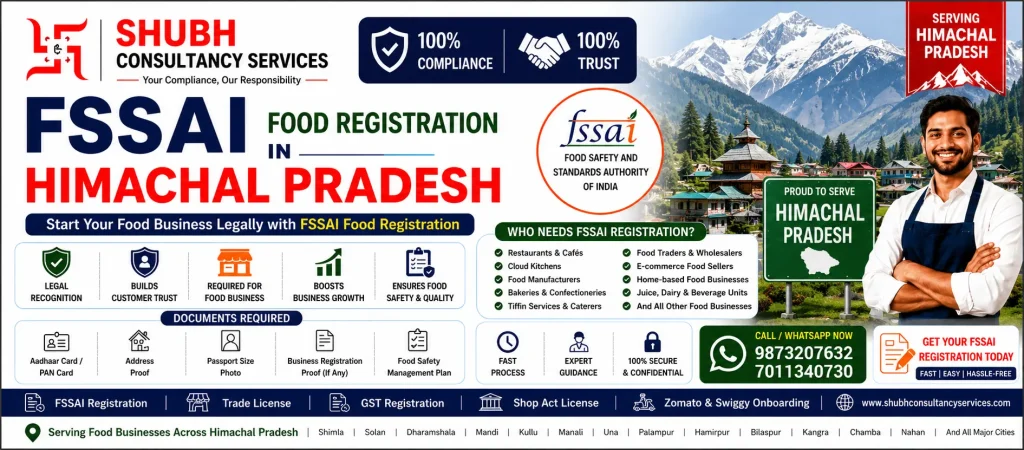
Get your FSSAI Food Registration In Himachal Pradesh
FBO Turnover Upto 1.5 Crore
- 1 year licence : 999 Rs
- 3 year licence : 1999 Rs
- 5 year licence : 2999 Rs
- All-inclusive, no hidden charges
FBO Turnover From 1.5 To 50 Crore
- 1 year licence : 3,999 Rs
- 3 year licence : 7,999 Rs
- 5 year licence : 11,999 Rs
- Govt Fees Extra
FBO Turnover greater than 50 Crore
- 1 year licence : 4,999 Rs
- 3 year licence : 12,999 Rs
- 5 year licence : 19,999 Rs
- Govt Fees Extra
FSSAI Food Registration in Himachal Pradesh: Complete Guide for Food Businesses
Starting or operating a food business in Himachal Pradesh comes with several legal responsibilities, and one of the most important is obtaining FSSAI Food Registration. Whether you run a small home kitchen, a café in Shimla, a restaurant in Dharamshala, a dairy unit in Kangra, or a food manufacturing company in Solan, complying with the Food Safety and Standards Authority of India (FSSAI) regulations is essential.
FSSAI registration is not just a legal requirement—it is a mark of trust and quality. It assures customers that your food products meet the prescribed safety and hygiene standards and are safe for consumption. Today, consumers are more aware of food safety than ever before, making FSSAI registration an important factor in building a credible and successful food business.
From small food vendors to large food manufacturers, every food business operator (FBO) involved in manufacturing, processing, storing, distributing, transporting, or selling food must obtain the appropriate FSSAI registration or license. The type of registration depends on factors such as annual turnover, production capacity, and the nature of business operations.
This comprehensive guide explains everything you need to know about FSSAI Food Registration in Himachal Pradesh, including eligibility, types of licenses, required documents, application procedure, benefits, validity, and frequently asked questions.
Why is FSSAI Food Registration Important in Himachal Pradesh?
Food businesses play a significant role in Himachal Pradesh’s economy. The state’s thriving tourism industry, expanding hospitality sector, flourishing apple orchards, dairy farming, food processing industries, and growing number of restaurants and cafés have created a strong demand for safe and high-quality food products.
To protect consumers and maintain food safety standards, the Government of India has made FSSAI registration mandatory for eligible food businesses.
Obtaining an FSSAI registration offers several advantages beyond legal compliance.
Ensures Legal Compliance
Operating a food business without the required registration may attract penalties under the Food Safety and Standards Act, 2006. Registering your business ensures that you comply with government regulations and avoid unnecessary legal complications.
Builds Customer Confidence
Customers prefer purchasing food products from businesses that maintain proper hygiene and quality standards. Displaying your FSSAI registration number on packaging, invoices, menus, and business premises increases customer trust and enhances your professional image.
Improves Business Reputation
An FSSAI-registered business is often viewed as more reliable than an unregistered one. Whether you are selling packaged foods, dairy products, bakery items, or restaurant meals, registration demonstrates your commitment to food safety.
Supports Business Growth
Many supermarkets, distributors, hotels, online marketplaces, and government departments require suppliers to possess a valid FSSAI license. Registration enables businesses to expand into larger markets and collaborate with reputed organizations.
Simplifies Regulatory Processes
Having an FSSAI registration makes it easier to obtain other business registrations, participate in government tenders, and apply for financial assistance or loans from banks.
Encourages Better Food Safety Practices
FSSAI promotes hygienic food handling, proper storage, quality control, and safe manufacturing processes. Following these practices reduces food contamination risks and improves overall business operations.
What is FSSAI Food Registration?
FSSAI Food Registration is an official authorization granted by the Food Safety and Standards Authority of India to businesses involved in food-related activities. It serves as proof that a food business complies with national food safety regulations and follows prescribed hygiene standards.
Every registered food business receives a unique 14-digit FSSAI Registration or License Number, which must be displayed on product labels, food packages, invoices, and business premises wherever applicable.
The registration system is designed to regulate food businesses of all sizes, from small street vendors to multinational food manufacturers. It creates accountability within the food supply chain while ensuring consumers receive safe and hygienic food products.
The type of registration required depends on:
- Annual turnover
- Nature of food business
- Production capacity
- Number of business locations
- Import or export activities
- Scale of operations
Businesses planning future expansion should carefully choose the appropriate registration category to avoid unnecessary modifications later.
Apart from fulfilling legal obligations, FSSAI registration strengthens brand credibility and helps businesses establish long-term customer relationships built on trust and transparency.
Types of FSSAI Registration in Himachal Pradesh
The Food Safety and Standards Authority of India categorizes food registrations into three different levels to accommodate businesses of varying sizes and operational capacities.
1. Basic FSSAI Registration
Basic FSSAI Registration is intended for Food Business Operators (FBOs) with an annual turnover of up to ₹1.5 crore. It is suitable for small-scale food businesses operating locally and involved in the manufacturing, processing, storage, distribution, or sale of food products. It is ideal for:
- Home-based food businesses
- Home bakers
- Small grocery shops
- Street food vendors
- Juice stalls
- Tea vendors
- Petty retailers
- Cottage food industries
- Small dairy vendors
- Temporary food stalls
The registration process is simple and requires minimal documentation compared to higher categories of FSSAI licensing. Applicants must provide basic business details and comply with the food safety and hygiene standards prescribed by FSSAI.
Obtaining Basic FSSAI Registration provides legal recognition to your food business, enhances customer confidence, and allows you to operate in compliance with food safety regulations while supporting future business growth.
2. State FSSAI License
A State FSSAI License is required for Food Business Operators (FBOs) with an annual turnover of more than ₹1.5 crore and up to ₹50 crore. It is suitable for medium-sized food businesses operating within Himachal Pradesh. This category includes:
- Restaurants
- Hotels
- Cafés
- Food manufacturers
- Food processors
- Catering companies
- Dairy processing units
- Cold storage facilities
- Wholesalers
- Distributors
- Food transporters
The State FSSAI License requires more detailed documentation than Basic Registration. Depending on the nature of the business, the Food Safety Department may also conduct an inspection of the business premises to ensure compliance with food safety and hygiene standards.
Obtaining a State FSSAI License allows businesses to expand their operations, supply products to supermarkets and retailers, partner with online food delivery platforms, and operate legally while maintaining compliance with FSSAI regulations.
3. Central FSSAI License
A Central FSSAI License is required for Food Business Operators (FBOs) with an annual turnover of more than ₹50 crore. It is also mandatory for businesses operating in multiple states, engaged in import or export activities, or involved in large-scale food manufacturing and distribution. This category includes:
- Food importers
- Food exporters
- Large food manufacturers
- Multi-state food chains
- Large warehouses
- E-commerce food operators
- Government food suppliers
- Major food processing industries
Applicants for a Central FSSAI License must meet stricter compliance requirements and submit comprehensive documentation. Depending on the nature and scale of the business, the Food Safety Department may conduct an inspection of the business premises before granting approval.
Obtaining a Central FSSAI License enables businesses to operate across India and in international markets, participate in large-scale commercial activities, and demonstrate compliance with the highest food safety and quality standards.
Who Needs FSSAI Food Registration in Himachal Pradesh?
Every individual or organization involved in the manufacturing, processing, packaging, storage, transportation, distribution, or sale of food products is considered a Food Business Operator (FBO) under the Food Safety and Standards Act, 2006. Such businesses are generally required to obtain the appropriate FSSAI Registration or License before commencing operations.
Whether your business is small or large, offline or online, obtaining FSSAI registration ensures legal compliance and demonstrates your commitment to providing safe and hygienic food products.
The following businesses commonly require FSSAI Food Registration in Himachal Pradesh:
Restaurants and Cafés
Restaurants, cafés, coffee shops, fast-food outlets, dhabas, and eateries serving prepared food must obtain the applicable FSSAI registration or license based on their annual turnover and business size.
Hotels and Resorts
Hotels, resorts, guest houses, and homestays that provide food services to guests are also covered under FSSAI regulations.
Home-Based Food Businesses
Individuals operating home kitchens, home bakeries, cloud kitchens, homemade pickle businesses, tiffin services, and snack manufacturing units must register with FSSAI if they are selling food commercially.
Food Manufacturers
Businesses involved in manufacturing packaged foods, bakery products, confectionery items, spices, edible oils, beverages, dairy products, frozen foods, or processed foods require the appropriate FSSAI license.
Grocery Stores and Supermarkets
Retail grocery stores, supermarkets, convenience stores, and kirana shops selling packaged food products are also required to comply with FSSAI regulations.
Dairy Businesses
Milk collection centres, dairy farms, milk processing units, paneer manufacturers, curd producers, and other dairy businesses must obtain registration based on their production capacity.
Fruit and Vegetable Businesses
Fruit sellers, vegetable vendors, apple processing units, jam manufacturers, juice processors, and food preservation businesses operating in Himachal Pradesh require registration under FSSAI.
Food Wholesalers and Distributors
Businesses engaged in wholesale supply, food distribution, storage, transportation, or logistics involving food products must possess the appropriate FSSAI license.
Online Food Sellers
Businesses selling food products through websites, e-commerce platforms, mobile applications, Amazon, Flipkart, Swiggy, Zomato, Blinkit, Instamart, or similar platforms must have a valid FSSAI registration.
Importers and Exporters
Companies importing food products into India or exporting food items internationally require a Central FSSAI License.
Regardless of the business model, obtaining FSSAI registration ensures that your food business operates legally and meets prescribed food safety standards.
Benefits of FSSAI Food Registration
Obtaining FSSAI registration provides several long-term benefits for food businesses beyond simply fulfilling a legal requirement.
1. Legal Recognition
An FSSAI registration legally authorizes your business to manufacture, process, store, distribute, or sell food products in accordance with Indian food safety laws.
2. Enhanced Customer Trust
Consumers are more likely to purchase food products from businesses displaying an FSSAI registration number. It reassures customers that the food they consume is prepared and handled under regulated safety standards.
3. Improved Brand Image
A registered food business is perceived as professional, reliable, and committed to maintaining quality. This significantly enhances brand reputation in a competitive market.
4. Business Expansion Opportunities
Many supermarkets, distributors, online marketplaces, hotels, and corporate buyers require suppliers to hold valid FSSAI registration before entering into commercial agreements.
5. Better Market Acceptance
Food products bearing an FSSAI registration number often gain greater acceptance among consumers, retailers, and wholesalers.
6. Easier Loan and Investment Approval
Financial institutions and investors generally prefer businesses that comply with statutory regulations. FSSAI registration strengthens your business profile when applying for loans or funding.
7. Increased Consumer Confidence
Food safety has become a major purchasing factor. Customers increasingly prefer businesses that openly demonstrate compliance with food safety regulations.
8. Supports Business Growth
As your turnover increases, you can upgrade your FSSAI registration category and expand operations without regulatory obstacles.
Documents Required for FSSAI Food Registration in Himachal Pradesh
The required documentation varies depending on whether you are applying for Basic Registration, State License, or Central License. However, the following documents are commonly required.
Identity Proof
Applicants may submit any valid government-issued identity document, including:
- Aadhaar Card
- PAN Card
- Passport
- Voter ID
- Driving Licence
Address Proof
Proof of the business location may include:
- Electricity Bill
- Water Bill
- Rent Agreement
- Property Tax Receipt
- Utility Bill
Business Registration Documents
Depending on the business structure, applicants may provide:
- GST Registration Certificate (if applicable)
- Shop & Establishment Registration
- Udyam Registration
- Partnership Deed
- Certificate of Incorporation
- Memorandum and Articles of Association
Passport-Size Photograph
A recent passport-size photograph of the applicant or authorized signatory.
Food Business Details
Information relating to:
- Nature of food business
- Food products handled
- Manufacturing capacity
- Storage facilities
- Machinery details (where applicable)
Additional Documents (If Applicable)
Some businesses may also need:
- NOC from Municipality
- Water Testing Report
- Food Safety Management Plan
- Layout Plan
- Import Export Code (IEC)
- Authority Letter
- Nomination Form
- List of Directors or Partners
Providing accurate and complete documentation helps avoid unnecessary delays during application processing.
Step-by-Step Process for FSSAI Food Registration in Himachal Pradesh
The registration process involves several stages designed to verify that food businesses comply with food safety regulations.
Step 1: Determine the Appropriate Registration Category
The first step is identifying whether your business requires Basic Registration, State License, or Central License based on turnover, production capacity, and operational activities.
Step 2: Collect Required Documents
Gather all necessary identity proofs, address proofs, business registration documents, and supporting records before beginning the application.
Step 3: Complete the Application
Fill out the prescribed application form with accurate business details, including the nature of operations, address, food products, production capacity, and contact information.
Step 4: Upload Supporting Documents
Attach all required documents in the prescribed format. Incomplete documentation is one of the most common reasons for delays or rejection.
Step 5: Department Verification
The Food Safety Department reviews the application. Depending on the license category, officials may seek clarification or conduct an inspection of the business premises.
Step 6: Approval and Certificate Issuance
Once the application is verified and approved, the FSSAI Registration Certificate or License is issued with a unique 14-digit registration number.
Businesses should display this registration number prominently at their premises and on food packaging wherever applicable.
FSSAI Registration Fees
The government fee for FSSAI registration depends on several factors, including:
- Type of registration
- License category
- Nature of food business
- Business turnover
- License validity period
- Production capacity
Professional consultancy charges, if applicable, are separate from government fees. Applicants should always verify the latest fee structure before submitting the application.
Validity and Renewal of FSSAI Registration
FSSAI Registration or License can be obtained for a validity period ranging from one to five years, depending on the applicant’s preference and eligibility.
Businesses should apply for renewal well before the expiry date to ensure uninterrupted operations. Failure to renew on time may lead to late fees, suspension, or cancellation of the registration.
Timely renewal also ensures continued compliance with food safety regulations and helps avoid unnecessary legal complications.
Penalty for Operating Without FSSAI Registration
Operating a food business without the required FSSAI registration or license is a violation of the Food Safety and Standards Act, 2006.
Depending on the nature and severity of the violation, authorities may impose:
- Monetary penalties
- Suspension of business activities
- Seizure of food products
- Cancellation of licenses
- Legal proceedings
- Closure of business premises in serious cases
Obtaining the appropriate registration before commencing business operations helps avoid these penalties and demonstrates your commitment to lawful business practices.
Why Choose Professional Assistance for FSSAI Registration?
Although the registration process is available online, many applicants face difficulties due to incorrect documentation, selecting the wrong license category, or incomplete applications.
Professional consultants can simplify the process by:
- Assessing the correct registration category
- Preparing and reviewing documents
- Filing accurate applications
- Coordinating with regulatory authorities
- Responding to departmental queries
- Assisting with modifications and renewals
- Minimizing delays and reducing the risk of rejection
Expert guidance allows business owners to focus on running their operations while ensuring compliance with food safety regulations.
Conclusion
Obtaining FSSAI Food Registration in Himachal Pradesh is an essential step for every food business seeking legal compliance, consumer trust, and sustainable growth. Whether you operate a small home-based food business or manage a large food manufacturing unit, an FSSAI registration demonstrates your commitment to maintaining high standards of food safety and hygiene.
Beyond fulfilling regulatory requirements, FSSAI registration enhances your business credibility, improves customer confidence, supports expansion into new markets, and opens opportunities to partner with retailers, online marketplaces, and government agencies.
If you are planning to start or expand a food business in Himachal Pradesh, applying for the appropriate FSSAI registration at the right time will help you operate smoothly, avoid legal complications, and build a trusted brand in the competitive food industry. By staying compliant with food safety regulations, you create a strong foundation for long-term business success while contributing to a safer and healthier food ecosystem.
Frequently Asked Questions (FAQs)
Yes. Every eligible Food Business Operator involved in manufacturing, processing, storing, transporting, distributing, or selling food must obtain the appropriate FSSAI registration or license.
Small food businesses with an annual turnover of up to ₹1.5 crore, such as home kitchens, petty food manufacturers, small retailers, grocery stores, and food vendors, are generally eligible.
The processing time depends on the type of registration, document verification, and whether a physical inspection is required.
No. Most e-commerce platforms and food delivery aggregators require sellers to possess a valid FSSAI registration or license.
Applicants can choose a validity period ranging from one to five years, subject to eligibility.
Yes. Renewal should be completed before the expiry date to avoid penalties and ensure uninterrupted business operations.
Yes. Changes such as business address, ownership, contact details, or business activities can be updated by applying for modification through the prescribed process.
Businesses operating without the required registration may face penalties, legal action, suspension of operations, or closure depending on the severity of the violation.